
A Christmas wreath made from things your garden already grew is a different kind of decoration. It smells like the season, it costs almost nothing, and when January comes it goes into the compost instead of a landfill. These eco friendly Christmas wreaths prove that the greenest holiday decor is also the prettiest, and every one of the fifteen ideas below can be made at home with materials most gardeners already have lying around.

Most store-bought wreaths are plastic greenery sprayed with fake snow and shipped halfway around the world. A natural wreath skips all of that. You work with what the season gives you: evergreen boughs, pinecones, dried seed heads, and a few kitchen scraps. The result looks like it belongs on your door instead of in a warehouse, and guests notice the difference.
Why an eco-friendly wreath beats the plastic one
The argument is practical, not preachy. A fresh wreath costs a fraction of a good artificial one, which can run forty dollars or more and still looks tired after three seasons. A foraged wreath is free apart from wire and ribbon, and you get to rebuild it differently every year, which is honestly half the fun. The scent alone is worth it: fir, pine, rosemary, and dried orange smell like Christmas in a way no plastic ever will.
There is also the end-of-season question. Plastic wreaths eventually go to the dump. A natural wreath gets composted, fed to the garden birds, or tossed on the brush pile, and the whole cycle starts again. That is the entire philosophy of sustainable Christmas decor in one wreath.
Start with a base that composts: 3 natural wreath frames

1. The grapevine frame. Prune your grapevine, clematis, or wisteria in late fall and you have wreath bases for years. Soak the flexible vines in warm water for an hour, then weave them into a circle about two inches thick, tucking the ends in as you go. A 24 inch frame takes twenty minutes and lasts for many seasons of rebuilding. Grapevine is also the backbone of the classic front door wreaths that keep coming back every December.
2. A willow or dogwood hoop. Red-twig dogwood, willow, and contorted hazel all bend into clean hoops when fresh cut. Bundle five or six stems, bend them into a circle, and lash the overlap with natural jute twine. The colored stems show through sparse greenery beautifully, so this base suits minimalist designs.
3. Reuse last year’s frame. The most eco-friendly frame is the one you already own. Strip last December’s wreath down to its wire or grapevine base, compost the spent greenery, and start fresh. One good frame can serve a decade of wreaths.
Forage the greens: 5 natural wreath materials from your yard
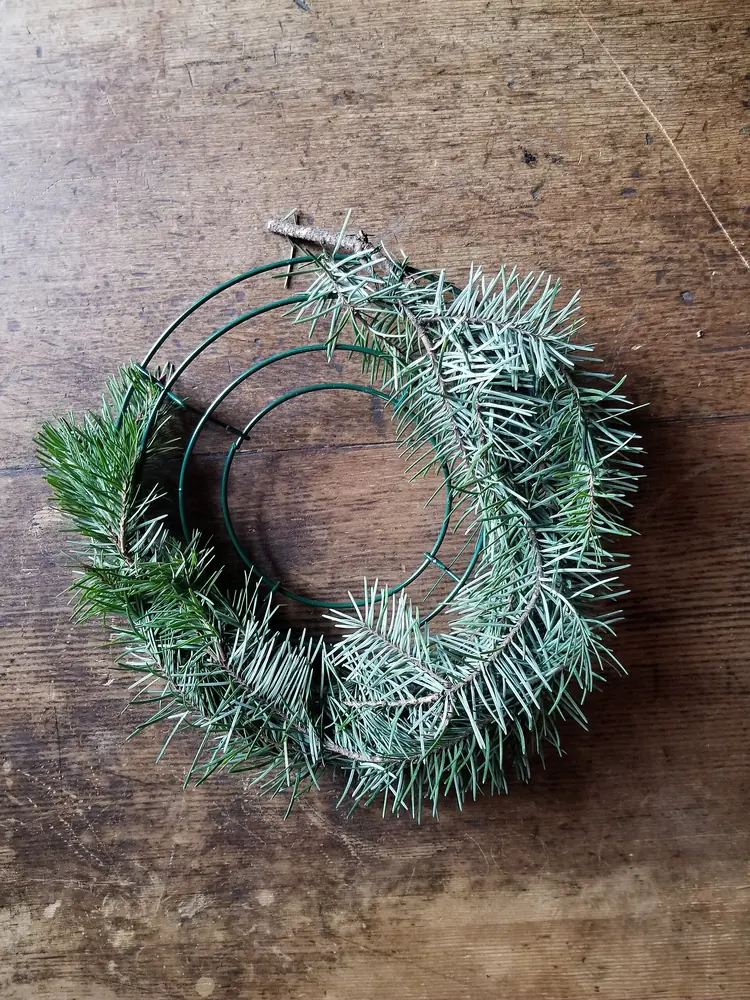
4. Mixed evergreen boughs. Fir, spruce, pine, and cedar are the workhorses. Cut 8 to 12 inch sprigs the week after Thanksgiving, bundle them in threes, and wire each bundle to the frame, overlapping like shingles. Three materials in one wreath (say, fir, cedar, and pine) gives texture that a single species never manages.

6. Dried orange and apple slices. Slice oranges a quarter inch thick, dry them at 200 F for about three hours, turning once, and they turn translucent amber. They thread onto wire or twine in minutes and add color that no berry can match. A dozen slices per wreath is plenty.
7. Eucalyptus and rosemary. Eucalyptus dries beautifully and keeps its silvery color for months. Rosemary sprigs add scent and a softer texture than conifer needles. If you grow either in a pot by the kitchen door, snip generously, they bounce back by spring. Tuck them in last so they sit on top of the heavier greens.

8. Holly and winterberry branches. Nothing says Christmas like red berries against dark green. Cut holly (Ilex) or winterberry (Ilex verticillata) branches with berries intact and wire them into the wreath in clusters of three. They hold their color for weeks in cold air and feed the birds once the wreath comes down.

Decorate without plastic: 7 sustainable finishing touches

9. Cinnamon sticks and star anise. Bundle three cinnamon sticks with twine and tuck them among the greens, or wire star anise pods in clusters. Both smell incredible and look like they came from an old-fashioned Christmas card. A one pound bag of cinnamon sticks decorates several wreaths for a few dollars.

10. Fabric ribbons from the scrap bin. Cut strips from old flannel shirts, linen napkins, or burlap coffee sacks for bows. They fray a little at the edges, which is exactly the rustic look you want. A simple looped bow wired at the bottom of the wreath is the classic finish.

11. Dried flowers from the summer garden. Hydrangea heads, strawflowers, gomphrena, and lavender all dry well and keep their shape through December. If you dried any blooms this summer, now is their moment. Tuck them deep into the greenery so they peek out.

12. Salt dough ornaments. Mix two cups of flour, one cup of salt, and one cup of water, cut into stars and trees, bake at 250 F for two hours, and you have ornaments that are fully compostable. Kids love making them, and a few hung on the wreath with twine make it personal in a way store ornaments never do.
13. Birdseed pinecones. Roll a few pinecones in peanut butter and birdseed and wire them into the wreath. The birds will find them within a day, and watching chickadees work your wreath in the morning is genuinely delightful. Use unsalted peanut butter.
14. Solar fairy lights. If your wreath needs sparkle, a short string of solar powered micro lights adds glow with no batteries and no outlet. Wrap twenty to thirty lights loosely through the greens. They charge by day and twinkle all evening.

15. Vintage and found objects. Old brass bells, wooden beads, a tarnished key, sea glass from a summer walk, a small framed photo under glass. The wreath becomes a little museum of your year, and every one of those objects beats a plastic bauble. For more front entry ideas that pair with a natural wreath, this Christmas porch decor guide shows how to build the whole entryway around it.
How to keep your eco friendly Christmas wreath fresh

Fresh greenery lasts three to four weeks in cold air if you treat it right. Hang the wreath on a covered porch or under an overhang, out of direct afternoon sun and away from the heat that leaks around the door frame. Mist it with water every two or three days, a quick spritz with a spray bottle is enough. Fir, cedar, and juniper hold needles longest; pine drops faster but looks fuller while it lasts. Take the wreath down by early January, before needle drop turns your porch into a mess.
One thing to skip: the temptation to spray everything with clear lacquer for shine. It seals in moisture unevenly, yellows in sun, and ruins the compostability you worked for. Let the materials look like what they are.
What to do with it in January

When the season ends, the wreath’s second life begins. Pull off the reusable bits first: the frame, wire, ribbon, lights, and any ornaments you want to keep. Compost the greenery, pinecones, dried fruit, and cinnamon, they break down beautifully. Toss the birdseed cones and berry branches near the feeders as a parting gift for the birds. The frame goes back on the shelf for next December. Zero waste, and you start next year with a head start. Out back, the same natural approach works for the whole yard, as these Christmas patio decorating ideas show.
Frequently asked questions
Is an eco-friendly Christmas wreath cheaper than a store-bought one?
Usually much cheaper. If you forage the greenery and pinecones, a wreath costs whatever you spend on wire and twine, often under five dollars. Even buying a grapevine base and a bag of dried oranges keeps you under fifteen dollars, against forty or more for a decent artificial wreath.
How long does a natural wreath last outdoors?
Three to four weeks in cold weather with occasional misting. Hang it in a sheltered spot out of direct sun and wind. Fir and cedar last longest; delicate materials like dried flowers fade faster but still look good for the season.
Can I make a wreath without buying craft supplies?
Yes, if you get creative. Prune vines for the frame, use garden twine or strips of fabric instead of floral wire where you can, and decorate with foraged cones, dried fruit from the kitchen, and garden clippings. The only thing most people buy is wire, and even that is optional with a sturdy vine frame.
Will a natural wreath survive rain and snow?
Light rain and snow are fine, evergreens evolved for it. What kills a wreath is repeated freeze-thaw cycles and wind, which dry the needles out. A covered porch or an overhang extends its life noticeably compared to a fully exposed door.
Conclusion
An eco-friendly Christmas wreath is one of those rare projects that is cheaper, prettier, and kinder than the alternative all at once. Start with a frame you will reuse, fill it with what your garden and kitchen give you, finish it with things that compost or keep, and hang it where the whole street can see it. Come January, the birds get the leftovers and the frame goes back on the shelf, ready for next year.
Photo credits: Natural wreath with dried oranges by Wikimedia Commons contributor (CC BY-SA 4.0); snowy wreath by Wikimedia Commons contributor (CC BY-SA 2.0); cork wreath by Wikimedia Commons contributor (CC BY-SA 3.0); wreath-making workshop by Wikimedia Commons contributor (CC BY-SA 2.0); paper wreath by Wikimedia Commons contributor (CC BY-SA 4.0); dried apple wreath by Wikimedia Commons contributor (CC BY-SA 4.0); foraged foliage wreath by Wikimedia Commons contributor (CC BY-SA 4.0); apple and pinecone wreath by Wikimedia Commons contributor (CC BY-SA 2.0).


2 thoughts on “Eco-Friendly Christmas Wreaths: 15 Sustainable Ideas for Your Front Door (2026)”